The Seduction of the Ineffective: A Scientific Deconstruction of Pseudo-Psychological Training Courses (Part One)
How the Wellness Industry Exploits Cognitive Biases to Sell Infallible Certainties at the Expense of Evidence
by Lorita Tinelli

Introduction: The Personal Transformation Market
In an era characterized by growing complexity, economic uncertainty, information overload, and a generally competitive climate, the human need for stability, control, and self-improvement reaches historic peaks.
It is in this fertile humus that a multi-billion dollar industry thrives: that of personal and professional training, which promises quick fixes, simple keys to success, and profound existential transformations.
These programs, often offered in the form of intensive courses and seminars, unfold in contexts that mimic the aesthetics of science without adopting its substance, leveraging deep and universal needs: the desire for belonging, the fear of being inadequate, the search for purpose.
The need for certainty makes the individual vulnerable to the allure of the promise of an absolute truth: a clear path to finally becoming free and happy.

Some may remember Kyle, the protagonist of the psychological thriller Rebirth (2016), an ordinary man who, at a certain point in his boring and ordinary existence, is invited by a friend to have a life-changing experience that will improve it, making him a new man, with more chances. Kyle rejects his life; he feels the need and necessity to change it but doesn't know how. That invitation, at that precise moment, seems like the right time to pursue other certainties. However, he doesn't know that the short course ("just a weekend") proposed by his smiling and apparently fulfilled friend will lead him to live a traumatic and shocking experience that, in turn, will induce him to finally switch off his own brain to submit to a system that offers simple answers to complex questions, no matter if they are illusory.
"Are you ready to live for two days an authentic experience of interpersonal contact? Many of you will be deeply disturbed by it. Don't worry, you are free to go back at any time, back to the world of the zombies. We will not do anything to you that goes against your morals". These are the phrases Kyle hears repeated on the bus taking him to the course that will mark his rebirth.
Here, however, by interacting with a series of characters Kyle meets on this harsh, revolutionary, enigmatic, and psychologically tense path, the man ends up alienated.
The reassuring, apparently empathetic phrases ("you can leave whenever you want," "I felt that way too, I understand you perfectly") together with the prospect of belonging to an exclusive group ("Rebirth is not for everyone", "you can return to the world of the zombies even now", "does anyone want to get off?") soon become psychological cages.
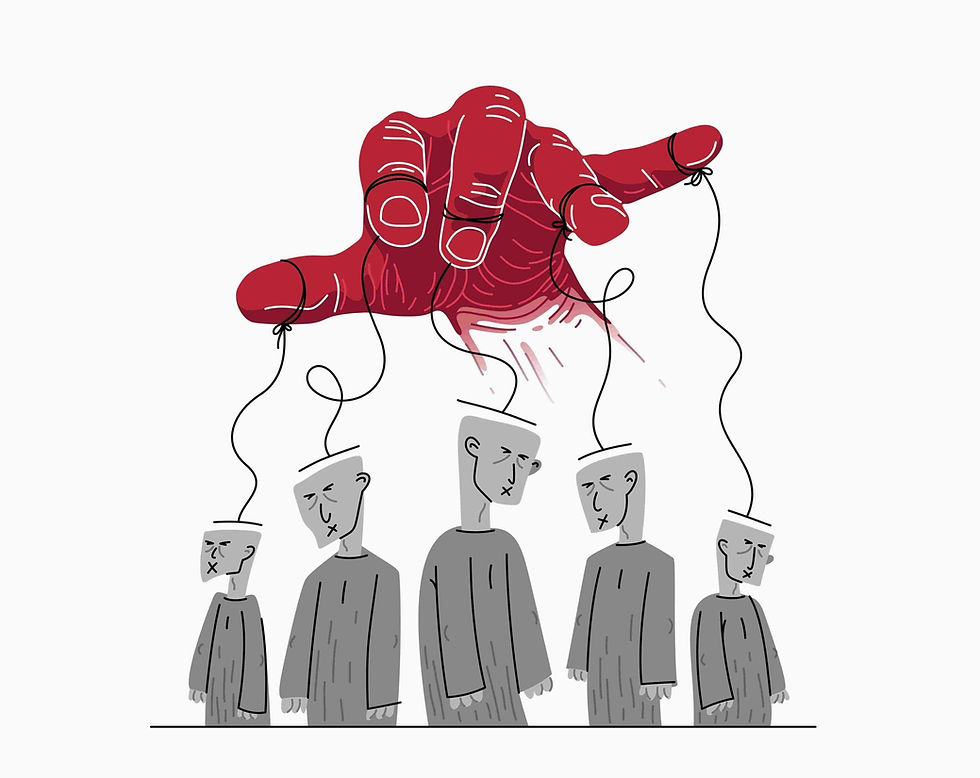
Communication in these environments is built on veritable manipulation strategies that create an illusion of control. In reality, the context and group pressure make it almost impossible for those involved to act freely.
A critical and scientifically informed analysis reveals that a significant portion of these "formative", "transformative" and "innovative" offers is not based on any solid empirical evidence; rather, their vacuous theoretical framework is based on psychological clichés and rhetorical strategies designed to bypass critical thinking.
This article, to be followed by others, aims to deconstruct, layer by layer, the shaky foundations of these programs, demonstrating how they often represent nothing more than traps for the gullible, cleverly disguised as paths to enlightenment. Veritable tricks to create ever more dependencies and enrich those at the top.
The analysis will focus on how many seminars proposed by various "Pied Pipers" use techniques and strategies clumsily readapted from Neuro-Linguistic Programming (NLP), the primary (and scientifically discredited) source from which most of their axioms are drawn, such as "the map is not the territory" or the "VAK categories (Visual, Auditory, Kinesthetic)".
The Art of Unscientific Persuasion and the Psychological Mechanisms Exploited

Before analyzing the content of the courses, it is crucial to understand why they seduce and persuade people.
Their effectiveness (commercial, not formative) lies in the systematic exploitation of well-known cognitive biases and heuristics, i.e., mental shortcuts the brain uses to make quick decisions, often unconsciously.
One of the most used shortcuts is the Forer (or Barnum) Effect
This phenomenon, studied by psychologist Bertram Forer in 1948, shows how individuals tend to accept vague and generic personality descriptions as deeply personal and accurate, descriptions that could apply to anyone. It is the effect that generates so much popularity for horoscopes and divinatory activities.
In the film directed by David Fincher, The Game, the protagonist Nicholas Van Orton, a cynical businessman obsessed with his father's suicide and closed off in a cold, solitary life, receives a subscription to a mysterious role-playing game organized by a shadowy recreational organization from his brother for his 48th birthday. Nicholas, after a series of psychological and physical tests, is drawn into a spiral of increasingly dangerous and surreal events that seem to speak directly to him.
In reality, many details are generic or constructed ad hoc, with vague descriptions of Nicholas's personality and life that are interpreted as personal and precise. Nicholas comes to question his sanity and his perception of reality but continues to slide deeper into the spiral, which seems to narrate the deepest part of his life.

In the film, the maid Christine, who becomes a key figure in the game, uses phrases so generic they could be true for anyone, such as: "I know you feel alone, but you're not the only one", "You're afraid of losing control, aren't you?", "You don't trust anyone, but deep down you wish you could". Nicholas interprets them as proof that she truly knows him and thus perceives her as a privileged reference figure. Someone who truly understands him.
Phrases like "sometimes you are insecure, but you have great unexpressed potential" or "you worry about the future, but deep down you are a sensitive person", "you can be the difference in your life", "what you believe, you achieve", are omnipresent in courses that promise magical improvements and create an illusion of personalization and depth. Anyone, at the first meeting proposed by self-proclaimed "transformers", perceives the sensation of being finally understood in their essence, welcomed and accepted in their limits, in a context of strong, loving interest (love bombing). It's as if those people, that environment, were there only for him and to allow him his long-yearned-for rebirth.
The Forer Effect is associated with several myths:
1) The narrative of the "lone hero", where individual genius is emphasized ("a single inventor against the whole world"), neglecting the historical context, economic resources, and teamwork that enabled a certain entrepreneurial success.
2) The exaggeration of initial failures, telling stories that had a miraculous outcome after several doors were slammed in one's face.
3) The myth of "pure passion", which omits that successful products are born from market analysis and not just from individual intuition.
This is how "motivational" tales emerge, emotional and simplified, often false, with the goal of making one believe that anyone can live a success story by following the instructions the course will be able to offer to "ignite the fire within you". Because "anyone can make the most of their mind's potential, including those they don't even know they have".

One of the motivational "fairy tales" told by various improvised instructors features a poor entrepreneur, Mr. Mattel, who lost everything in the 1929 crisis in the United States and found himself begging on the streets.

One day, a compassionate woman gave him a small coin that would only be enough to use the public bathrooms for a shower. Mattel doesn't know what to do. He feels the need to wash, but as he approaches the bathrooms, he meets another compassionate man who holds the door open for him, allowing him to wash for free. That small coin will be Mr. Mattel's ascent to entrepreneurial success in the toy field. He will thus build the Mattel empire, known throughout the world.
Too bad Mr. Mattel never existed, and Mattel, founded in 1945 in Los Angeles, took its name from the combination of its founders' surnames: Matson and Elliot.
The false story aims to promote the oversimplified concept of "we can [achieve] what we want," so that everything becomes possible, if one truly wants it.
Various groups use motivational videos, but also jingles, theme songs, and background music to emphasize personal power. This music, often paired with effective phrases and suggestive images, serves to give the unfortunate participant the illusion of already being in the "magical phase" of transformation and appropriation of their own power.
Here is an example in Italian
Authority and Technical Jargon
The trainers, as solicitors of hidden talents, often present themselves as "master coaches", "communication experts", "experts in strategic learning and memorization", with self-conferred titles and anecdotes of success. They all claim to have refined techniques, applying them to their personal and professional lives and achieving surprising results in all fields.

They adopt a jargon that mimics scientific language ("neuro-connectors", "submodalities", "limbic resonance") to confer an aura of legitimacy and complexity to concepts that are often banal or unfounded.
Social psychologist Robert Cialdini defines the principle of authority as one of the modes capable of persuading people. Indeed, he explains that people are more likely to follow the directions and advice of figures they perceive as authoritative or expert. This effect manifests because people tend to trust those who demonstrate competence and confidence in their statements, relying on them with blind obedience.
Consistency and Commitment
Once an individual has invested economically (high course fees) and emotionally (admitting they have a "need") in a path, the psychological drive to justify that investment becomes powerful. Abandoning the course would mean admitting to themselves that they wasted resources, an admission the brain seeks to avoid (cognitive dissonance).
One therefore tends to overestimate its benefits, even when they are scarce compared to the unpleasant trials they must endure.

Social Proof and Group Emotional Contagion
The group environment is a powerful catalyst.
The sharing of emotional experiences, often facilitated by techniques of conversational hypnosis or group pressure dynamics, creates a sense of community and shared "truth." Seeing other participants enthusiastic or emotionally involved acts as a powerful social signal ("if it works for them, it will work for me too").
Therefore, it often happens that during thematic sessions, participants are induced to talk about themselves, often in an apparently spontaneous way, but in reality guided by psychological dynamics and persuasion strategies used by the group leader.
This is not accidental and responds to the need to induce a lowering of others' defenses, strengthen the individual's identification with the group, and make participants more receptive to the trainer's messages.
These mechanisms are not chosen at random; they are tested rhetorical weapons that weaken the defenses of critical thinking and prepare the ground for the uncritical acceptance of content.
In the next article, I will analyze the use of Neuro-Linguistic Programming in trainers' programs and their effects on their students, with practical examples taken from the groups I have studied.
In the next article, I will analyze the use of Neuro-Linguistic Programming in trainers' training programs and its effects on their students, using practical examples from the groups I studied.
Bibliographical References
Cialdini, R., (2022). Le armi della persuasione. Come e perchè si finisce per dire di sì. Giunti editore.
Corballis, M. C. (1999). Are we in our right minds?. In Mind myths: Exploring popular assumptions about the mind and brain (pp. 25-41). John Wiley & Sons.
Lilienfeld, S. O., Lynn, S. J., & Lohr, J. M. (Eds.). (2014). Science and pseudoscience in clinical psychology. Guilford Publications.
Marzari, M., Tinelli L. (2023). Sette e manipolazione mentale. Piemme.
Pashler, H., McDaniel, M., Rohrer, D., & Bjork, R. (2008). Learning styles: Concepts and evidence. Psychological science in the public interest, 9(3), 105-119.


Commenti